A Very Short History of Portglenone Parish Church
Located on the corner of the Townhill Road and Cullybackey Road, Portglenone Church of Ireland is one of the oldest churches in the area. It was consecrated in the 1730s by Bishop Francis Hutchinson. This parish, which is within the Diocese of Connor, also includes St Colmanell’s Church of Ireland in Ahoghill. The Ahoghill church opened in August 1865.
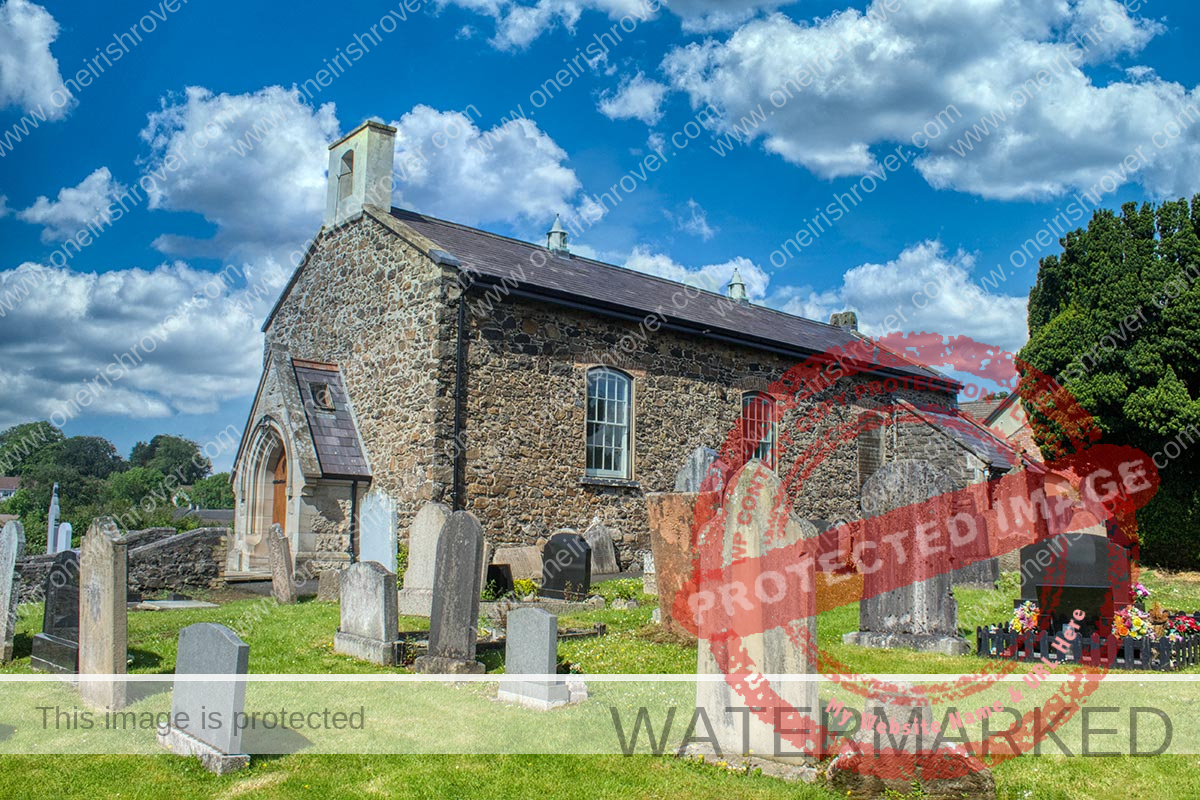
There are reports that the original seceders in Portglenone worshipped, for a time around 1821, in the court building in the market square area of the village.
The church received official parish status in 1840.
During the 1900s, there were several renovation projects.
On the 13th February 1912, a service of dedication was held for the newly constructed church porch.
In 1929, the church was made higher (among other things) and had a new roof installed. The extensive renovation work took six months to complete. During that time, Mr. James Brady allowed the church to hold it’s services in the village’s Town Hall.
In April 1929, the Northern Whig reported that:
Where Does the Time Go To?
I was only once inside this beautiful old church. It is a very vague memory from 1972, 73 or 4. It was a church service that the children of nearby Portglenone Primary School attended. We were escorted the few hundred yards, by our teachers. Would it have been a pre Christmas service? Maybe a fellow Portglenone Primary School student, of this early 1970s era, can help me out.
Here I was, back in June 2019, nearly 50 years later. Two hours were spent, in the fading summer light, taking several hundred photos. I did return, in the subsequent week, when the sun would briefly show it’s face, and took additional photos of the church itself (which you can see above and below).
The Oldest Headstones
There is a very old gravestone that is nearly impossible to read, from what seems to be from a July in the early 1700s (maybe 1717) of someone called John O’Hamil or maybe O’Hara. It’s hard to determine the surname.
The Bishop of Down and Connor, Francis Hutchinson, who died in 1939, lies in a vault with family members below the communion table (more on him a little later).
The two oldest gravestones in the churchyard, that I could find, were that of 70 year old Henry Keenan who died on March 15th 1784; and John Hill who died in June 1784.

The next oldest appears to be that of 17 year old Elizabeth Fowler (see the photo on the right), who died on the 3rd September 1792.
There is also a gravestone “to the glory of God and in memory of the Lyttle and Hogg families who are interred in this churchyard from the year 1796.”
Around the turn of the century, we see the graves of a Ballinafie family – 60 year old Agnes Dick who died in October 1798 and her husband 70 year old James Dick, who died in March 1802. Their son Andrew Dick died in February 1819.
Margaret Boyd, 56 years old, was buried here in January 1818. Her husband Thomas Boyd lies beside her, having died in October 1827. He was 71 years old.
Grace Glass was 76 when she passed on in October 1824.
Probably the saddest grave that I encountered was that of the McAteer family. Alexander McAteer, from Gortfad, was only 33 years old, when he died on the 8th January 1841. His wife Mary McAteer (nee Bell) was also 33 years old when she died 17 days later, on the 25th January 1841. Their five children had died in infancy.
Dr. Francis Hutchinson, Bishop of Down and Connor
Dr. Francis Hutchinson, Bishop of Down and Connor, who consecrated the Portglenone church when it opened in the 1730s, is interred in a vault under the church’s communion table. He was 80 years old when he died in June 1739 and according to his inscription, the church was built mainly at his expense. Born in Derbyshire, England, he preached in earlier times at St James in St Edmundsbury. His widow Anne is also buried beside him. She survived him by 19 years.
Hutchinson’s great-grandson, John Hamilton O’Hara (1757 to 1822) of Portglenone and Crebilly, is interred in the same vault, along with several other members of the family.
Reverend Edward Hudson & Reverend Thomas Dysart
The Rev. Edward Hudson, Rector of Ahoghill, died in May, 1804, aged 62. He was buried in the aisle of the Portglenone church. Beside him lies the remains of his wife Elizabeth, who died in October 1835, aged 93.
The Rev. Thomas M Dysart lies in the graveyard. He was reared in the local townland of Bracknamuckley. Dysart was ordained in First Newton Hamilton on the 14th December 1875; resigned that role on the 5th July 1887; then installed in Mallow on the 11th July 1887. He retired on the 21st June 1913; and died at 77 years of age, on the 19th May 1927.
A local Justice of the Peace (JP) is buried in the graveyard. Thomas Madden was 62 when he died on the 12th December 1947.
Alexander Family of Portglenone
The Alexander name is very prominent in the history of Portglenone. In the graveyard, and inside the church, the name appears frequently.
There are references to the most Reverend Nathaniel Alexander D.D.P.C., Lord Bishop of Meath (born 17 June 1788, died 25 July 1840); also his eldest son, the Ven. Robert Alexander, Archdeacon of Hillsborough and of Portglenone House.
Robert Alexander I.C.S. died at Portglenone House in June 1896 and his wife Louisa passed away in January 1902. Their son, also named Robert Alexander, and who also resided at Portglenone House, contributed a window to the church, with had the inscription “This window is erected by their son Robert Arthur Alexander. “So he bringeth them unto the haven where they would be.”” His youngest daughter, Clare Florinda, who was the wife of the Lieutenant Commander R A Cassidi R.N., is also buried in the churchyard (born 8th February 1896 – died 30th March 1925).
I will return to this section at a later date, because there are several more Alexanders to add (including one who served as an MP at Westminster in the 1840s).
American Connections (plus one Australian)
There is a reference to an Adam Bell (died 1920) and his wife Ann Bell (died 1913) of Gortfad. Their daughter Mary J. Bell died in the USA on the 11th September 1916.
Stewart Cairns (died in 1930, aged 93 years) of Lisnagarron put up a headstone in memory of his young 20 year old wife Nancy Cairns (died August 1861). It also references his daughter Jane who died in Baltimore USA on the 6th July 1894, aged 33 years; and also his daughter Mary J who died at Baltimore USA 8th February 1920, aged 51 years.
John Crosset, of Portglenone, makes mention on his headstone to his grandson George Booth who died at 65 years of age, in Buffalo, USA, on the 24th October 1938.
A San Francisco man, H. C. Hamilton, erected a headstone for his parents, Patrick Hamilton (died 24th April 1891, aged 78 years) and Mary (died 13th November 1896, aged 81 years).
I did find a small stone (see below) which said “In Loving Memory of sister Elizabeth McClure. From Mae and Dan McClure, U.S.A.”. However I wasn’t able to decipher the larger headstone above (and possibly related to the smaller stone).

James Crawford (who died 25th June 1897, aged 78 years) and his wife Betty Hilton (who died 7th January 1911, aged 89 years) of Lisrodden had a son, James Crawford, who died in Melbourne, Australia, 18th November 1908, aged 53 years.
Killed in Belfast Blitz
John Miller (54 years old) and his wife Mary Jane Miller (49 years old) are buried in the graveyard. They were natives of Portglenone and had many family and friends in the area. They had moved to Belfast and lived at 24 Hogarth Street, in the Tigers Bay area of the city. Along with many others, they were killed when the nazis bombed Belfast on a late night air raid on the 15th April 1941 (and into the early hours of the 16th).
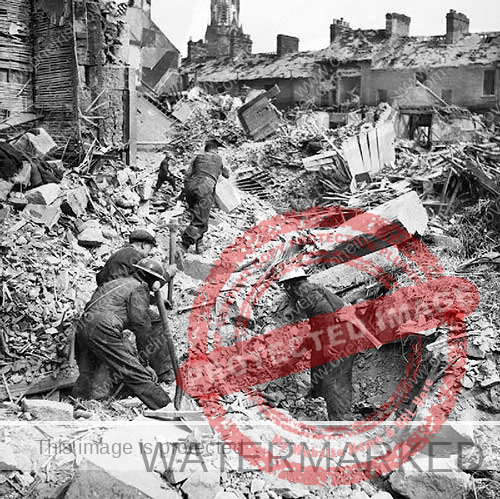
On that night, nearly two-hundred Luftwaffe bombers participated in the second, and largest, of four raids on Belfast. Over nine-hundred people were killed during that hellish night – and some 1500 were injured. The death toll was the biggest loss of life in any nazi night raid outside London.
The Millers were brought home and buried in Portglenone. The death notice in the Belfast Telegraph and the News Letter said:

The Gravestones
Derek mentions that the correct spelling of the area is “Bracknamuckley” and goes on to add that “Mary Ann died 5 years later on 24th October 1918 and her age was given as 83. I reckon this is fairly accurate as Henry was born 1836/7 and they were both 19 when they married in 1856. Her death is recorded at “I wonder if the reason Henry married at 19 was due to his mother’s remarriage. I think Andrew, Henry’s father, died in 1843 and Elizabeth married James Kyle in 1849. I recently discovered from the Braid site an Andrew Clements in Aughnahoy Old Cemetry and the dates all fit.” “Infant mortality was high in those days and I suspect it was something they were well used to unlike today.” “Sadly, my father Harry, predeceased his mother Agnes in 1968. Always a sad situation when a parent outlives them. James, my uncle, was a well-known fiddle player, and I believe quite talented.”
https://civilrecords.irishgenealogy.ie/churchrecords/images/deaths_returns/deaths_1918/05174/4427647.pdf


What a wonderful tranche of work.
The headstones look quite large, is there a bit of one-upmanship!
Looking at some of the names on the headstone transcripts, I am prompted to investigate further connections into our Mulholland tree (not that the same names confer a family connection), both the distant past and the current generation.
That’s a very good point, Barry. I hadn’t thought about that aspect.
I don’t know about bigger, but there does seem to be more old surviving gravestones in this graveyard. Maybe that is merely because there were more folk buried in this graveyard, and thus the chances of headstones surviving a few hundred years is greater. Or maybe folk in the village had more money, and/or better access to a gravestone maker/inscriber (than say the rural Innisrush graveyard three miles away).
Regarding names in the churchyard – with going back so long, into the 1700s and early 1800s, there are some names that have long since died out (like Chaine and Renison) – and other names (like Cassidi) that are now spelled differently…..and a name like Fife, that suggests the plantation immigrants from Scotland.
That’s my Portglenone cemetary work done now. This and the old Presbyterian churchyard at https://www.oneirishrover.com/second-portglenone-church-old-cemetery/ is now complete. Plus the catholic one at https://www.oneirishrover.com/aughnahoy-catholic-graveyard/
Tamlaght Lower is complete – Tamlaght Upper is near impossible (with the old stones largely unreadable). So now in the future, I can focus on the nearby villages of Kilrea, Maghera, Ahoghill and Cullybackey. I took nearly 30,000 photos in 6 weeks last summer! This project is gonna take several years, God-willing.
Thank you for putting together this lovely website and transcriptions of Gravestones.
An eye catcher for me was your transcription of ( Workman ) , Ivé Workman’s, Campbell’s and Dempsey’s to chase around In Antrim… and I am pretty sure the one you have transcribed is my Workman Ancestors.
Loved the Poems and Snippets of History.
Hello Lesley. Thank you for the lovely message. It’s a labour of love – and an ongoing project, that will hopefully eventually cover up the entire Bann Valley, from Toome to Coleraine. I have a number of new graveyard posts currently in various states of completion. Working with all the photos isn’t easy. I took them all in RAW format, so each photo is anywhere from 20MB to 70MB. Anyways, slowly making progress.
Great that you are seeing connections re Workman. There are Workmans in Portglenone to this day.
There are Dempseys and Campbells in the nearby Tamlaght area. Those names can be found in Tamlaght Upper graveyard. I haven’t got around to transcribing the photos of Tamlaght O’Crilly Upper as yet – largely because the very old stones in that graveyard are sadly unreadable.
Delighted to hear you like the website.
All my best regards.
Your hard work is appreciated now and no doubt it will be into the future.
The preservation of these old and not so old at the moment, Gravestones and the transcription of them is fabulous.
I don’t doubt the Workman’s, Campbell’s and Dempsey’s could still be in or around their birth lands, alas my lot left Ireland for Scotland…. and to add to that lot, I’ve Bell’s and Scott’s to add to the mix 😉 that’s just my maternal line…
I also forgot to add I love the layout of the site too….
If you should ever need any help, with your transcriptions and if I can help , just ask….
Lesley, you have made my week. Thanks so much for the lovely positive feedback.
I wish I had started the site 15 plus years ago. In the past few years, many members of the family have passed on. I did scan the family trove of photos in the early 2000s.
The look/theme for the website was initially one of a very professional modern look. But I decided in November 2019, that I wanted an old fashioned font-feel – well the look of the typeface anyway. It took me back some 40 years to the old office typewriters that I used to plod along on (and got laughs from others at how slow I was).
More and more people are finding the site. I looked at the traffic data today. It’s great to see that people are starting to discover the site. I am clearly not alone in wanting to preserve the past and bring history to life.
May I ask how you initially found the site – google, email, friend, or social media?
Re Bells – there are still Bells in Portglenone. Indeed, when I went to Portglenone Primary School in the late 60s, early half of the 70s, there were Bells there.
Yes, there is a big Scotland connection with this part of the world. There are areas near Portglenone where it’s very obvious in the dialect. Reminds me, I must post some related Irish-Scots poetry. There is a poem on this site, that in places is almost a different langauge 🙂 https://www.oneirishrover.com/auld-whiskey-bar-bridge/
Thanks for the offer of help. That is so kind. Perhaps you could help me a little, in future, with the two remaining churches in Tamlaght (Tamlaght Upper and Churchtown). Some of those graves may be of interest to you.
I know what you mean, I wish I had started my genealogical research project long before my family members had passed on. So many question I have for them, that now have to go unanswered… and so many photo’s of family members with no names on them….
So I have learned a lesson or two, I’ll no put off something till the morn, cause the morn’s morn may never come.
I love the Font and yes you are right it is like a typewriter, that brought back some memories, black fingers after changing the tape and the corrector thread, for when you had to fix your mistakes… The font is so easy to read and is pleasing on the eye.
Loved the Poem : “The Old Whiskey Bar at the Bridge” I remember when my Grandfather, used to pop down to the Orbiston, or as it was locally known the “Orb” in Bellshill, which was just doon and aroon the corner from where he lived. I think he and his old pals had been frequenting the Orb, from his days in the Mines and for sure it was as similar to the wee poem as read.
I found your site via a random family name search on Google search….
I have my family tree on a site called Wikitree. Would you mind if I put a link to your Website on my Workman’s profile.
Thanks, I would love you to put a link to this website on your wikitree page. That would be great.
Yes, typewriters – black ribbon and the white tipex was all too commonly needed for my typing mistakes. I should have bought shares in Tipex.
So your grandfather was from Bellshill area. Yes, there are many smilar words used in Scotland and N. Ireland.
When I go through all the older gravestones, there are so many Scottish type surnames….some with different variations of spelling, and some surnames now long since gone.
Yes, re time slipping on. For me, the big thing is the old photos and old stories. One ends up with old photos, but with no way of telling who the people in the photos are. Thankfully I have got most of my old photos worked out. But I find it sad that like an old computer hard drive, with someone’s passing, goes a whole trove load of great stories and insights about the past…gone for ever….irreplaceable. The even sadder thing is, older folk would (in most cases) love to be asked about their life, and to share their stories and insights.
One of my ideas for the future on this site, is to put together a survey/questionnaire, which will allow older folk to discuss their earliest memories, local area, local yarns, etc. i.e. to put it all down (even maybe record the audio).
I have a few questions in mind – but will need to get folks input.
What a great idea to get some of the older members of the region to talk about their life and times past. As you say once they are gone we have lost our connection to them and the local history of the country and for sure they would have some great stories to tell.
Tipex , what was that? …. We had a little thin piece of white paper you had to place on the incorrect typed letter on the page, then without hitting your finger re-type the correct letter… Many a times I had a black pointer finger with so many different letters typed on it….
Yes my Irish ancestors , I believe went to Glasgow first, then onto Bellshill, Airdrie, a few ventured a wee bit further north but they were mostly in Bellshill. Coal mining family.
Thank you for allowing me to link to your site.
Welcome. It is great to get your link to oneirishrover.
re tipex – you have jangled my memory – yes, you are right. We weren’t allowed tipex – it had to be that wee bit of white paper thing you mentioned above (held over the mistake and retyped).
Yes, coal mining and all that heavy industry, is now long since gone in the entire region. So many skill-sets lost these past 50 years.
Re writing down of folks memories. I need to start that project soon and put together a rough guideline of questions to ask. With smartphones now, it is even easier to record their memories, rather than them have the hassle of typing them down.
By the way, in the future, if you would ever be interested, it would be good to get a page done on your tree and links to the area, on this site. Only if you are interested though.
I’ve got a wee story to share , that was sent to me by my first cousin once removed.
“When I was very young my Gran Campbell took me to visit her sister Nan who married a McNeil.
They lived in a room in someones home in the Coal Miners Rows in Viewpark just past Bellshill. I always remember it not so clean.
Anyway when we got back to Grans house she went on about Nan having sent her son to Ireland to live with Grandparents and never seeing him again
I think they were poor and could never afford to bring him back but Gran said she would have swam all the way to get her son and would never have left him there”.
My cousins account of an time gone by enabled me to step into a wee snippet of their life, something I would have not been able to do if this wee story was not told and then lost forever.
Your project to talk to the older folk in our community is a wonderful idea and for sure start sooner rather than later as once they are gone we will lose that connection to the past. Some of the folks might think what they have to say is not important but it is.
Re my tree and a wee page, I’ll give it a shot and see how I go 🙂
Lesley, thanks for that story.
It’s great that you got to hear that story – even though it is heartbreaking, when one thinks about her never seeing her son again. And Ireland is so close to Scotland. On a good summer day, I used to be able to see the Mull of Kintyre from the coast in Northern Ireland. It stretches out into the Irish Sea.
Yes, re stories – every month sees more of the older generation slip away.
I think by this point, it may well be a case in most instances, of a son or daughter retelling a story/memory of their parent/grandparent.
A great source for those of us wanting to know a bit more about our ancestors in the area. Clearly a labour of love and many thanks for your time and effort.
I do notice one omission, that of the family of my great grandfather Henry Clements. I can understand why as the headstone is badly weathered and almost illegible. Fortunately, I took a photo a few years ago and have transcribed it. I am happy to forward this to you if you wish.
Hi Derek. Thank you for your lovely words. Yes, it’s a labour of love. I think, well in my case anyway, when you reach a certain age, and the generation above are nearly all gone, that you want to write important things down and leave something behind.
A big regret of mine, is not hitting PLAY and RECORD on the tape recorder in the 1970s, when my grandparents were still around (my paternal grandfather was born in 1896 and had a lot of memories).
Yes, please, I would love that transcription of your great grandfather’s grave.
You are correct, sometimes a headstone is badly weathered, and I don’t take a photo, or else I just can’t make enough out when I look at the photo later. Other times, I just simply don’t see a headstone.
I will drop you an email.